
Local SEO for Dentists
Get your practice into the Google Maps Pack, where most local dental searches actually convert.
Think about the last time you searched for a local business on Google. Before the organic blue links, you likely saw a map with three business listings directly below the search bar. That section is the Google Maps Pack, and for dental practices in the UK it is where the majority of local patient searches end.
When someone types “dentist near me” or “dental implants Birmingham” into Google, their eyes go to the map first. The three practices listed there get the bulk of clicks from that search. Organic results below the map get what is left.
Local SEO is the process of making sure your practice is one of those three.
Local SEO: What It Is and How It Differs from General SEO
General SEO focuses on improving your website’s ranking in organic search results through content, technical improvements, and backlinks. Local SEO focuses specifically on your visibility in location-based searches, which for dental practices is where almost all new patient traffic comes from.
The signals that determine local rankings are different from those that determine organic rankings. A technically excellent website with great content can still rank poorly in the Maps Pack if the local signals are weak. A practice with a well-optimised Google Business Profile, a strong review base, and consistent local data can outrank a competitor with a much bigger website.
For dental practices, local SEO is not a secondary consideration. It is the primary one. Most new patients are searching within a few miles of your practice. Local visibility is what puts you in front of them at the moment they are ready to book.
Why the Google Maps Pack Matters for Your Practice
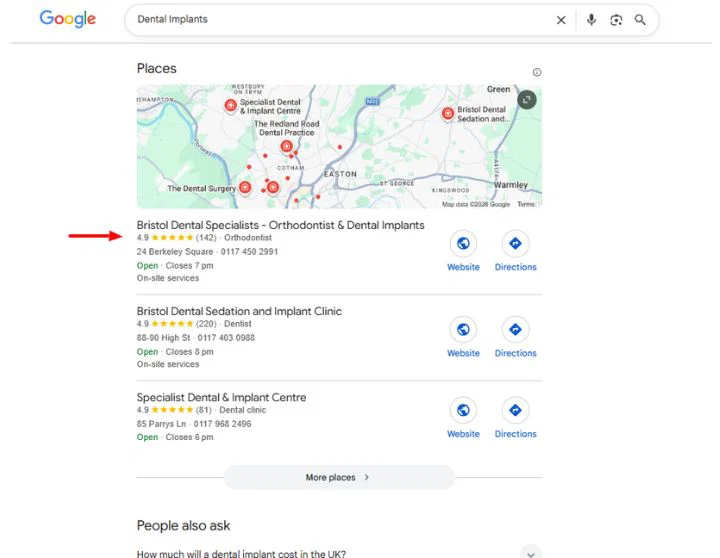
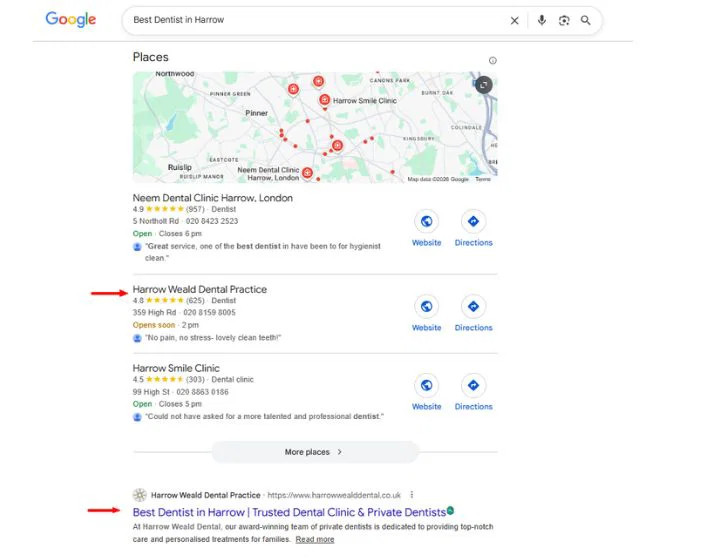
The Maps Pack is the block of three local business listings at the top of Google search results for location-based queries. It shows the practice name, star rating, address, phone number, and a link to the full Google Business Profile.
For dental searches, the Maps Pack captures the majority of clicks on the page. Patients searching locally tend to go straight to those three listings because they immediately show the information they want: how close is this practice, what is the rating, can I call directly.
Getting into the Maps Pack for your target area is often more valuable than ranking first in the organic results below it.
Google decides which three practices appear based on three factors:
- Relevance: how closely your Google Business Profile matches the search
- Distance: how close your practice is to the person searching
- Prominence: how well-known and trusted your practice appears based on reviews, links, and online presence
Distance is the one local ranking factor you cannot control. Relevance and prominence are where the work happens, and both can be significantly improved with the right approach.
Google Business Profile Optimisation for Dentists
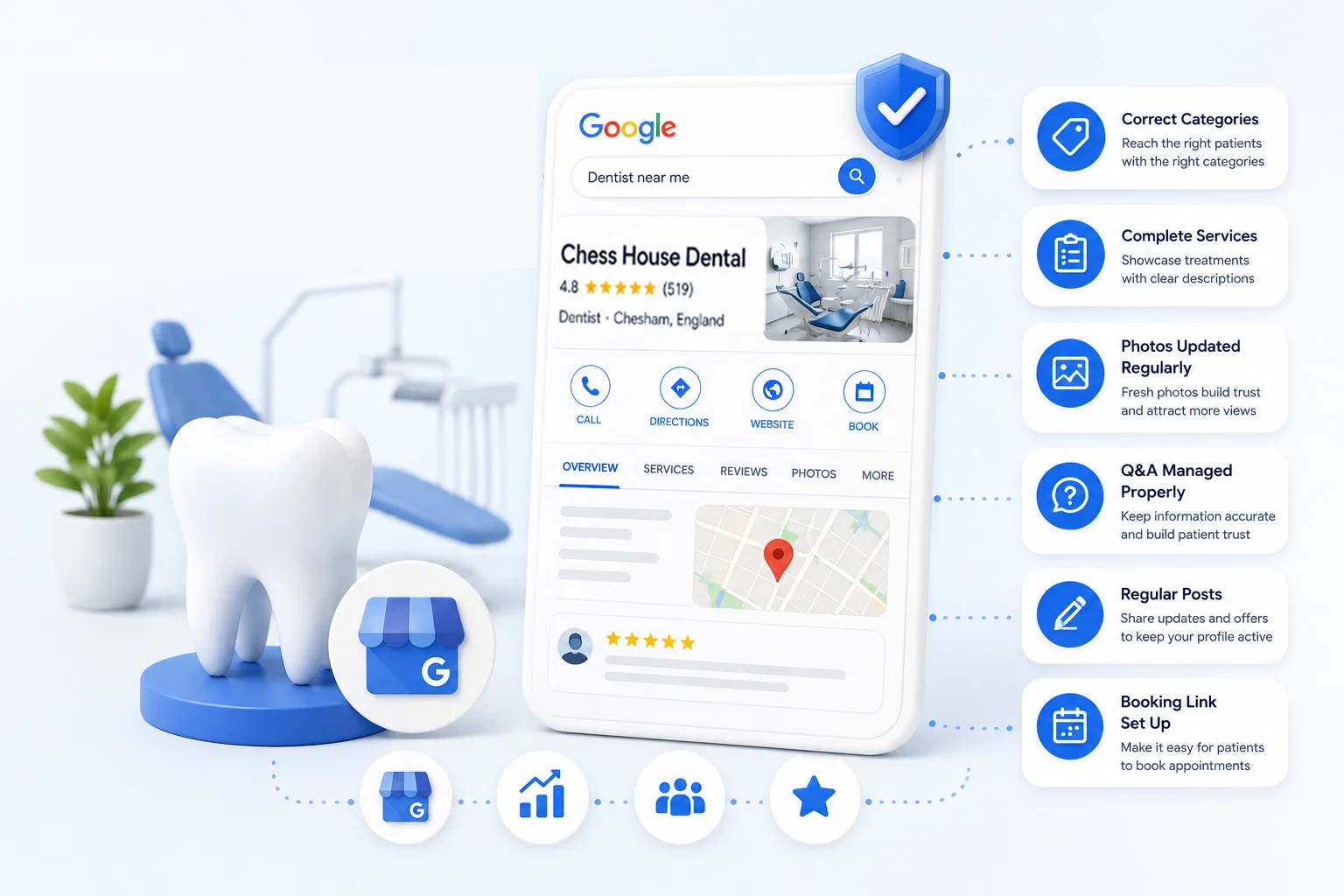
Your Google Business Profile is the single most important asset in local search for a dental practice. Most practices have a profile. Very few have one that is properly set up.
A half-complete profile gives Google less information about your practice, which means Google is less confident showing it for relevant searches. Here is what a properly optimised GBP looks like.
- The correct primary and secondary categories
The primary category should be “Dentist.” Secondary categories should reflect your specific treatments: “Cosmetic Dentist,” “Orthodontist,” “Dental Implants Periodontist,” and so on. The categories you select directly affect which searches your profile is eligible to appear for. - A complete services section
Google lets you list specific services with descriptions. Most practices leave this section blank or barely filled in. Completing your treatment list with clear descriptions tells Google exactly what you offer and helps your profile appear for treatment-specific searches. - Photos updated regularly
Practices with more photos consistently receive more profile views. This includes photos of your exterior, reception, treatment rooms, and team. Regular uploads signal to Google that the profile is active and maintained. - Q&A section managed properly
The Q&A section on your GBP is publicly editable. Anyone can post a question and, in some cases, anyone can post an answer. Leaving this unmanaged risks incorrect information sitting on your profile unchallenged. We monitor and manage this so nothing misleading stays live. - Regular posts
GBP posts work similarly to social media posts but appear directly on your profile in search results. Posting consistently about treatments, offers, and practice news keeps your profile active and gives Google fresh signals about your practice. - Booking link set up correctly
If your practice uses an online booking system, the booking link on your GBP should go directly to the booking page, not your homepage. Every extra step a patient takes before booking is a point where they can drop off.
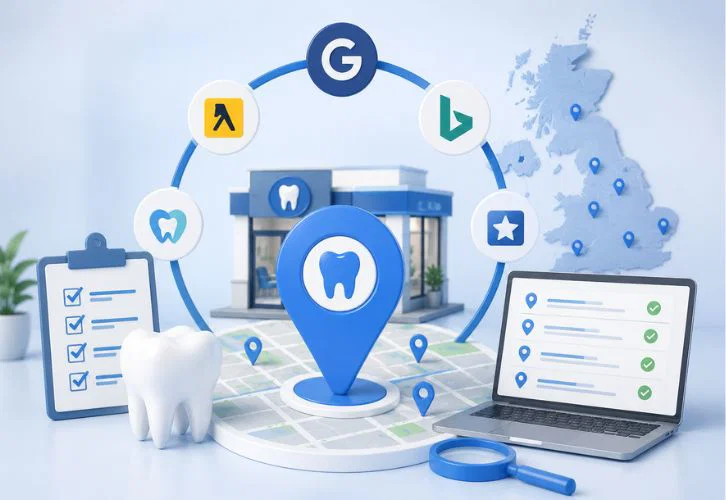
Local Citations and NAP Consistency
A local citation is any mention of your practice name, address, and phone number on another website. This includes dental directories, health directories, and general listing sites like Yell, Thomson Local, and Bing Places.
Citations matter for two reasons. First, Google uses them to verify that your practice is a real, established business at a real address. More consistent citations across trusted sources increase Google’s confidence in your listing. Second, patients sometimes find practices through directories directly, so the listings are worth having on their own merits.
The issue most practices have is consistency. If your practice name appears differently across sites (“Riverside Dental” on one listing, “Riverside Dental Practice” on another), or if an old address is still showing on some directories after you moved, those inconsistencies send conflicting signals to Google and can push your Maps Pack position down.
We audit your existing citations, correct inconsistencies, and build new listings on the directories that carry the most weight for dental practices in the UK.
Reviews and Their Role in Local Rankings
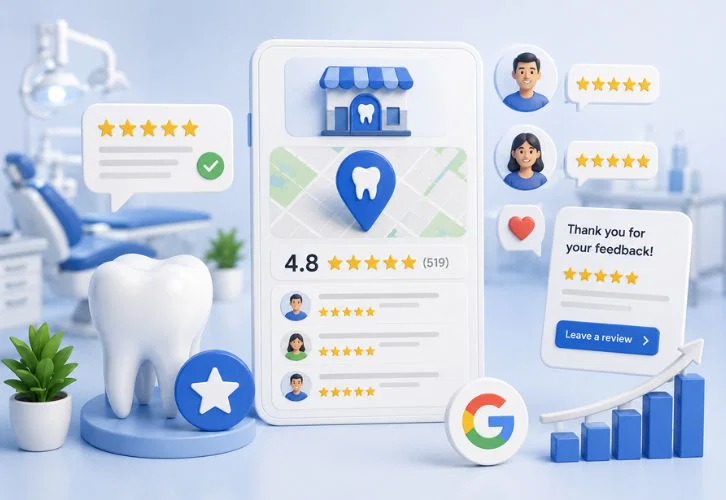
Reviews are a direct ranking factor in the Google Maps Pack. A practice with 200 reviews at 4.8 stars will almost always outrank a practice with 20 reviews at the same rating, when other factors are similar.
Beyond rankings, reviews are also a conversion factor. A patient comparing two practices in the Maps Pack will look at review count and recent comments before clicking. A strong review profile builds trust before a patient has ever visited your website.
The challenge most practices face is not that patients are unhappy. It is that asking for a review feels awkward, or it simply gets forgotten in a busy day. We build a structured review collection process that makes it straightforward for your team to consistently gather reviews from satisfied patients.
We also monitor your reviews across Google and other platforms and flag anything that needs a response. How a practice handles a negative review tells potential patients as much about the practice as the review itself.
Location-Specific Landing Pages
For practices serving multiple areas or competing in a large city, location-specific pages on your website are one of the most effective ways to extend local search visibility.
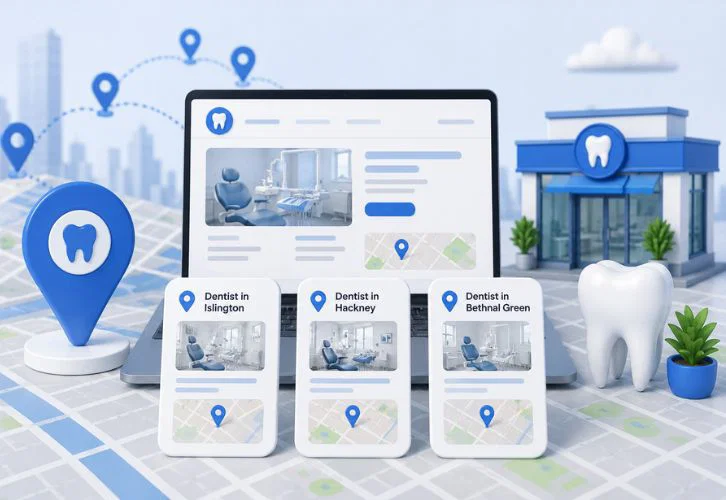
A location page targets a specific town, district, or postcode. Instead of one general page saying “dental practice in London,” you have individual pages for “dentist in Islington,” “dentist in Hackney,” and “dentist in Bethnal Green,” each targeting the searches patients in those areas are actually making.
These pages work alongside your GBP rather than replacing it. They give Google more signals about where you serve and what you offer in each area, and they give patients arriving from a specific local search a page that speaks directly to their location.
For a single-location practice, a well-optimised GBP combined with locally relevant content on the main website is usually enough. For multi-location practices or those in large competitive cities, dedicated location pages make a clear difference.
What Our Local SEO Service Includes
Google Business Profile audit and full optimisation
We review your current profile, identify every gap, and complete a full setup covering categories, services, photos, Q&As, booking link, and posting schedule.
Local citation audit and cleanup
We check where your practice is listed, identify NAP inconsistencies, correct errors across existing listings, and build new citations on high-authority dental and health directories.
Local keyword research
We identify the specific local searches your patients are making, by treatment type and by location, and build your GBP and on-site content around those terms.
Location page creation and optimisation
Where relevant, we write and optimise location-specific landing pages to extend your visibility across the areas you serve.
Ongoing GBP management
We post to your profile regularly, respond to reviews in your voice, and monitor the profile for any unexpected changes or issues.
Monthly reporting
Your monthly report covers GBP performance data (profile views, search queries, calls, and direction requests), local keyword ranking movements, and review growth.
What to Expect and When
- Single-location practices competing against well-established local competitors
- New practices that need to build local visibility quickly
- Practices with incomplete, outdated, or incorrectly set up GBP listings
- Practices that have moved premises and have old addresses showing across directories
- Multi-location dental groups needing consistent local SEO across all sites
- Practices that rank well organically but are not appearing in the Maps Pack
This Is What Your Patients See Before They Visit Your Website
When someone searches for a dentist or a specific treatment on Google, the Maps Pack appears before anything else on the page. Three practices, a star rating, and a phone number. Most patients pick from these three and never scroll further down.
Your Google Business Profile, review count, and local signals decide whether your practice is in that list or watching from below it.
Find Out Where Your Practice Stands in Local Search
We offer a free local SEO review where we look at your Google Business Profile, your current Maps Pack position for key searches in your area, and what your nearest competitors are doing that you are not. You come away with a clear picture of the gaps and what it would take to close them.
FAQs about dental SEO services
Local SEO for dentists covers Google Business Profile optimisation, local citation cleanup and building, review collection and management, local keyword research, and location-specific landing pages. Together these improve how often your practice appears in the Google Maps Pack for searches like “dentist near me” and treatment-specific local queries.
Regular SEO focuses on your website’s position in organic search results through content, technical improvements, and links. Local SEO focuses on your visibility in location-based searches, particularly the Google Maps Pack. The ranking factors are different. Local SEO is driven primarily by your Google Business Profile, reviews, and citation consistency rather than website authority alone.
Almost certainly. Having a profile and having an optimised one are two different things. The most common issues we find are incorrect or incomplete service categories, no treatments listed in the services section, few photos, unmanaged Q&As, and no regular posting activity. Each gap reduces how often and how prominently your profile appears.
There is no fixed number, but more reviews from real patients consistently outperforms fewer. In most UK local markets, being competitive in the Maps Pack requires at least 50 to 100 reviews. In major cities, leading practices often have 200 or more. Review velocity also matters. Practices that collect reviews steadily outperform those with a large count that has not grown in months.
Yes, this is one of the most common situations we deal with. Old addresses on directories create inconsistencies that confuse Google and can suppress your Maps Pack ranking. We audit all your listings, update them to the correct information, and correct anything that cannot be updated through standard processes.
Each location needs its own Google Business Profile, its own citation set, and its own local content on the website. We manage each location as a separate entity while keeping the overall strategy consistent. Multi-location groups often benefit significantly from local SEO because strong profiles across multiple locations reinforce the brand’s overall visibility.
We manage it on your behalf. You retain full ownership of the profile at all times. Any significant changes are discussed with you first, and if you ever move to a different provider, access stays with you.