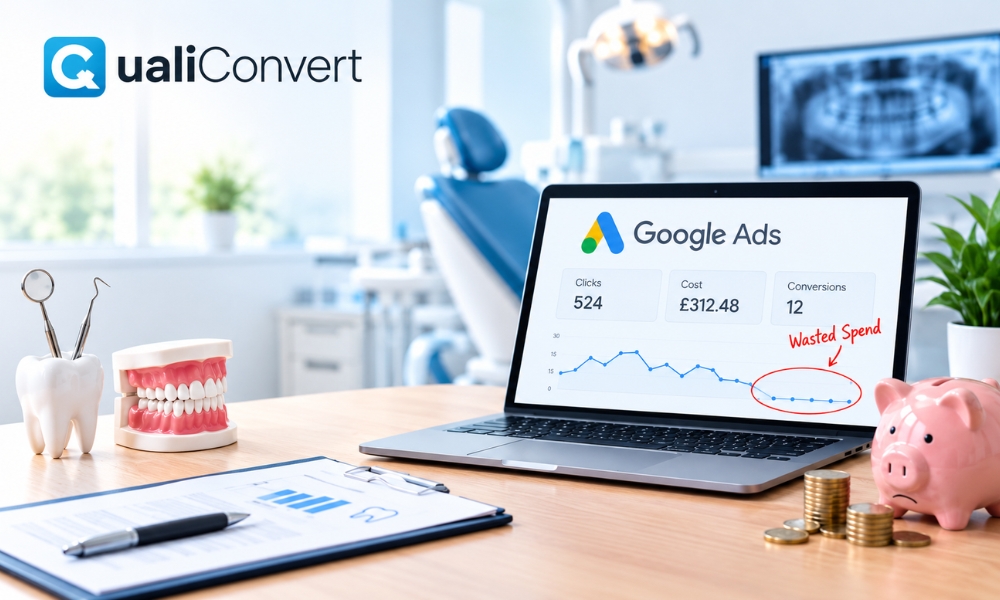
Most dental practices that tried Google Ads and gave up did not have a bad idea. They had a leak.
The ads ran, the clicks came in, the budget went out, and somewhere between the click and the booking, the money quietly disappeared. Nobody could say exactly where. So the campaign got paused, and Google Ads went on the list of things that “do not work for dentists”.
It does work. Dental keywords are some of the most valuable in local search precisely because a single implant or Invisalign patient can be worth thousands. But the margin for sloppiness is small, because dental clicks are expensive and the competition knows what it is doing.
This guide walks through where the money actually leaks, and how to plug each gap. If you are running ads now, you will probably recognise at least two of these. If you are thinking about starting, you will save yourself a costly first six months.
Leak One: Bidding on Words That Never Become Patients
The fastest way to burn a dental ad budget is bidding on searches that sound relevant but are not.
“Teeth whitening” looks like a great keyword. It is also typed by people looking for whitening strips on Amazon, curious teenagers, and students writing essays. You pay the same for those clicks as you do for a genuine patient enquiry.
What separates a profitable campaign from an expensive one is intent. Look at the difference:
- “dental implants” is research, often months from booking
- “dental implants cost near me” is closer, actively comparing
- “emergency dentist open now” is someone reaching for the phone
The third type costs more per click and is worth every penny. The first type will happily eat your entire monthly budget and leave you with nothing to show for it.
Two practical fixes make an immediate difference. First, build your campaign around treatments with real commercial value and clear intent, rather than general dentistry terms. Second, use negative keywords aggressively. Blocking words like free, cheap, jobs, training, DIY, courses and salary stops a surprising amount of waste on day one. Most struggling accounts we look at have almost no negative keywords at all.
Leak Two: Sending Every Click to Your Homepage
This one is common and expensive.
Someone searches for dental implants, clicks your ad, and lands on a homepage that talks about your practice, your team, your opening hours and your full range of treatments. They have to hunt for the thing they came for. Many will not bother.
Every ad should lead to a page about the specific thing the ad promised. Someone searching for Invisalign should land on a page about Invisalign, with the price range, what the process involves, how long it takes, and an obvious way to book.
A good landing page for dental ads does four things:
- Answers the question the search asked, in the first screen
- Gives real information, including cost ranges, rather than “prices on request”
- Shows proof: reviews, before and after photos where appropriate, clinician credentials
- Makes booking obvious, with a phone number and booking button visible without scrolling
Match matters more than beauty here. A plain page that answers the exact question beats a beautiful page that makes people search for it. If your website generally struggles to turn visitors into enquiries, fixing that before increasing ad spend is the single highest return decision available to you, and our guide to websites that book more patients covers how.
Leak Three: Advertising When Nobody Can Answer the Phone
Here is an uncomfortable question. If your ads run at 8pm on a Sunday, who answers?
Dental searches spike outside working hours, because that is when people have time to think about their teeth, and when toothache tends to feel worst. Paying for those clicks with nobody available to respond is paying to send patients to whichever practice replies first, which is usually a competitor the next morning.
You have two sensible options, and most practices should use both.
Control when your ads run. If nothing is in place to catch out of hours enquiries, restrict your ads to times when someone can answer. You will spend less and convert more of what you do spend.
Or catch the enquiries automatically. A chatbot or automated enquiry system on your landing pages captures details at 10pm and puts them in front of reception first thing. This is where paid traffic and automation earn their keep together, and it is what our lead conversion services are built to handle.
Either way, do not pay for attention you cannot receive.
Leak Four: Measuring Clicks Instead of Patients
Ask a practice how their ads are doing and you often hear about clicks, impressions or click-through rate. None of those pay salaries.
Clicks, impressions and CTR can help diagnose campaign performance, but cost per enquiry and cost per booked patient tell you much more about whether your advertising is actually generating value. To see them, you need three things in place:
- Call tracking, so you know which calls came from ads rather than guessing
- Form and booking tracking, so online enquiries are recorded properly
- A simple record of what happened next, ideally noting which enquiries became patients and for which treatment
That last point is the one almost everyone skips, and it is the one that changes decisions. A campaign generating enquiries at £40 each looks fine until you learn those enquiries are mostly hygiene appointments. Another campaign at £90 per enquiry looks expensive until you learn a third of them book implant consultations.
Without this, you are optimising blind, and you will usually optimise towards the cheap clicks that matter least.
Leak Five: Fiddling Constantly, or Not at All
Both extremes cost money.
Practices that log in daily and change bids on a hunch never give the campaign long enough to gather data, so every change is a guess reacting to another guess. Practices that set it up once and leave it for a year end up paying old prices in a market that moved, with competitors bidding against them and search terms drifting.
A sensible rhythm looks like this. Weekly, scan the search terms report and add negative keywords for anything irrelevant. Monthly, review cost per enquiry by treatment, shift budget towards what converts, and pause what does not. Quarterly, revisit your landing pages and ad copy properly.
That is enough. Anything more is usually anxiety rather than optimisation.
What Budget Do You Actually Need?
Enough to gather data. That is the honest answer.
A campaign spending £200 a month in a competitive city will produce a handful of clicks, no meaningful patterns, and no way to tell what is working. There is no single budget that works for every dental practice. Your required spend depends on your location, treatments, competition and average cost per click. The important thing is having enough budget to generate sufficient data to judge what is and is not working.
Two things to remember. Paid ads stop generating traffic when the budget stops, while SEO can continue generating organic visibility beyond the initial investment, although ongoing optimisation is usually needed. And ads are usually best used alongside organic work rather than instead of it, filling the diary now while organic visibility builds for later. We compared the trade-offs in our channel-by-channel budget guide.
The Short Version
If you do nothing else after reading this:
- Add negative keywords this week. It is free and it stops waste immediately.
- Send each ad to a page about that exact treatment, not your homepage.
- Turn ads off during hours you cannot respond, or install something that captures enquiries when you cannot.
- Track enquiries and bookings, not clicks.
- Review monthly, not daily.
Do those five and most of the leaking stops.
When It Is Worth Handing Over
Google Ads punishes part-time attention. The accounts that perform are the ones somebody checks regularly, with landing pages built for the campaign and tracking wired up properly.
Our Google Ads for dentists service covers paid campaigns alongside SEO, landing pages and lead capture, so the clicks you pay for land somewhere built to convert them and nothing gets lost in between. There is no long-term contract, and you see cost per enquiry rather than a report full of impressions.
If you are already running ads and suspect money is leaking, book a free consultation. We will review your account, show you where the waste is, and tell you whether it is fixable in-house before we talk about anything else.