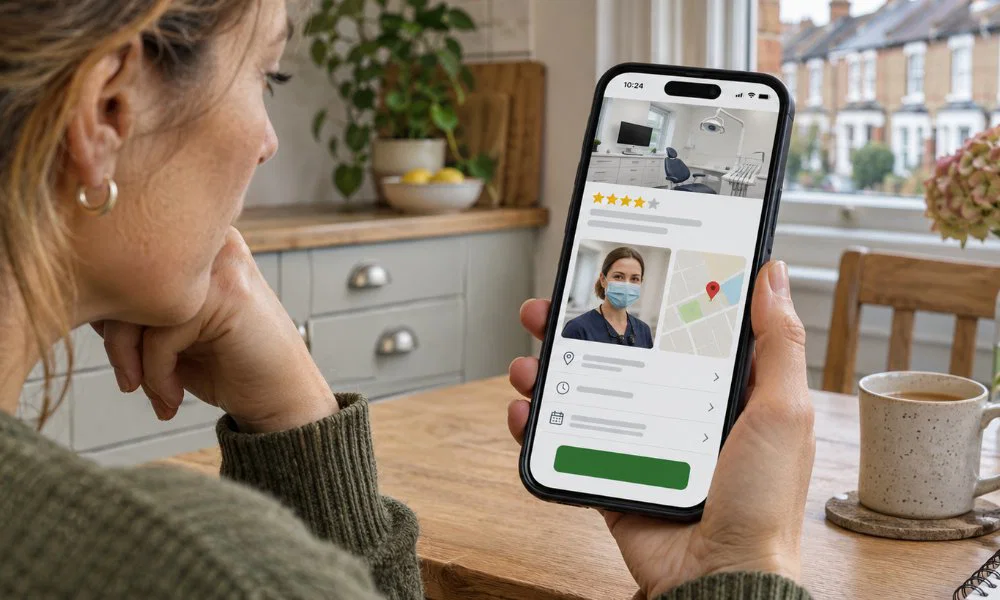
Choosing a dentist is not like choosing a takeaway. People take their time, and they are quietly nervous while they do it.
What most practice owners never see is the checking that happens before the phone rings. Somebody finds you, looks you over, compares you with two other practices, and makes a decision. All of it happens without you knowing they existed.
Understanding that process is useful, because every stage has a point where people drop out. Here is what they actually look at, roughly in order, and what makes them leave.
1. Are You Nearby, and Are You Open?
The first filter is brutally practical, and it happens in seconds on a Google results page or map.
They are looking for: roughly where you are, whether you are open now or soon, your star rating, and whether getting to you looks like a nuisance.
Where practices lose people here:
- Opening hours that are wrong or missing, especially around bank holidays
- No indication of parking or transport
- A profile that looks neglected, with old photos or none at all
This is the cheapest stage to fix, because it is mostly admin rather than marketing. Keeping your listing accurate and active is the foundation of our local SEO for dentists work, and our guide to getting found in nearby towns covers how far that reach can extend.
2. What Do Other Patients Say About You?
Reviews come next, and people read them more carefully than you might think.
They check how recent the reviews are, because a great rating from two years ago suggests a practice that used to be good. They deliberately read the worst ones, to see what the bad day looks like and how you responded. And they look for themselves in the detail. Someone anxious is scanning for other anxious patients. A parent is looking for mentions of children.
What loses people: silence. An unanswered complaint sitting at the top of your reviews does more damage than the complaint itself. A calm, professional reply, which never discusses anyone’s treatment publicly, often wins people over entirely.
3. Can They Find Out What It Costs?
This is where the most enquiries are lost, and it is the stage practices most often get wrong.
Nearly everyone wants a sense of price before they contact you. Not an exact quote, which they understand is impossible. Just a range, so they know whether they are in the right place at all.
A page that says “prices on request” or “contact us for a quote” reads as evasive. Many people simply go to a practice that answered the question. Others ring, ask, and are told they need a consultation first, which has the same effect.
An honest range works better for everyone. It filters out people who were never going to proceed, and it warms up the ones who will, because by the time they contact you they have already accepted the number. Just make sure anything you publish includes every charge they cannot avoid, which our guide to pricing and review rules explains.
4. Who Will Actually Be Treating Them?
Once price is settled, it becomes personal. People want to know who is going to be holding the drill.
They look for faces, names, qualifications, and some sense that a human being works there. Stock photography of models with unnaturally white teeth does the opposite of reassurance. A simple, honest photo of your real team beats a polished image of strangers every time.
Worth including on your team page:
- A proper photograph of each clinician
- Their qualifications, where they trained, and their GDC registration number
- What they particularly focus on, especially nervous patients or children
- One human detail, because it makes them a person rather than a credential
This matters twice over. Patients use it to decide whether they trust you, and search engines and AI tools use the same signals to judge whether real, qualified people stand behind your content.
5. Does Your Website Feel Like a Real Practice?
While all this is happening, people are forming an impression of competence from the website itself. Mostly unconsciously, and mostly on a phone.
Things that quietly cost you patients:
- Slow loading, which many will not wait through
- A phone number they have to hunt for
- Text too small to read without pinching
- A contact form that asks for far too much before they have decided anything
- Anything that looks abandoned, like a copyright date from years ago or news from a season that has passed
None of these are about design taste. They are about whether the practice looks like it is being run properly. If you want the detail, our guide to websites that book more patients goes through it.
6. Is Contacting You Going to Be Awkward?
The last hesitation is social, and it is the one practices almost never address.
People worry about being judged. They have not been for years, they know their teeth are not great, and they are bracing for a lecture. Some of them get this far, read everything, and still do not ring.
What helps, more than any marketing tactic:
- Saying plainly that you see plenty of patients who have been away a while, and that nobody gets a telling-off
- Offering a way to ask a question without committing to an appointment
- Making the first step small and specific, like a short consultation with a clear price
- Being reachable in more than one way, since some people will never ring but will happily message
This is also the stage where out-of-hours enquiries pile up, because people work themselves up to it late at night. Something that captures that moment, rather than leaving them to try again tomorrow when the nerve has gone, converts more of them than anything else. That is what our lead conversion services are for.
Do This Walkthrough Yourself
Take your phone, search for your main treatment plus your town, and go through the whole journey as a stranger would. Do not use your website’s menu. Start from the search results, exactly as a patient does.
At each stage, ask one question: would I keep going, or would I try the next practice?
Most practice owners find at least two things they had never noticed, usually a missing price, an unanswered review, or a phone number that is harder to find on mobile than it is on a desktop.
Then do the same for the two practices that rank above you. Not to copy them, but to see what a patient sees when they compare.
The Pattern Behind All Six
Each stage is really the same question asked differently: can I trust these people?
Accurate details show you are organised. Recent reviews show other people keep choosing you. Honest prices show you are not hiding anything. Real faces show who you are. A working website shows competence. Warm wording shows you will be kind.
Practices that quietly nail all six do not need clever marketing. They need to be found, which is the part we handle through our dental SEO service.
If you would like someone to run that walkthrough properly and tell you exactly where people are dropping out, book a free consultation and we will go through it with you.
FAQs
Location and practicality come first, checked in seconds: where you are, whether you are open, your rating, and whether getting to you looks easy. Only after passing that filter do people start reading about you properly.
Publishing honest ranges usually produces better enquiries, because patients self-select before contacting you. Pages that refuse to discuss cost tend to lose people to practices that answered the question openly.
Often because something made contacting you feel awkward or uncertain: no price guidance, no sense of who works there, an unanswered negative review, or no easy way to ask a question without committing to an appointment.
Very. Patients want to see who will treat them, particularly nervous ones. Real photographs with names, qualifications and GDC numbers build far more trust than stock images, and they also strengthen how search engines judge your site.