Ask yourself a quick question. When was the last time a new patient told you they found your practice by scrolling through page two of Google?
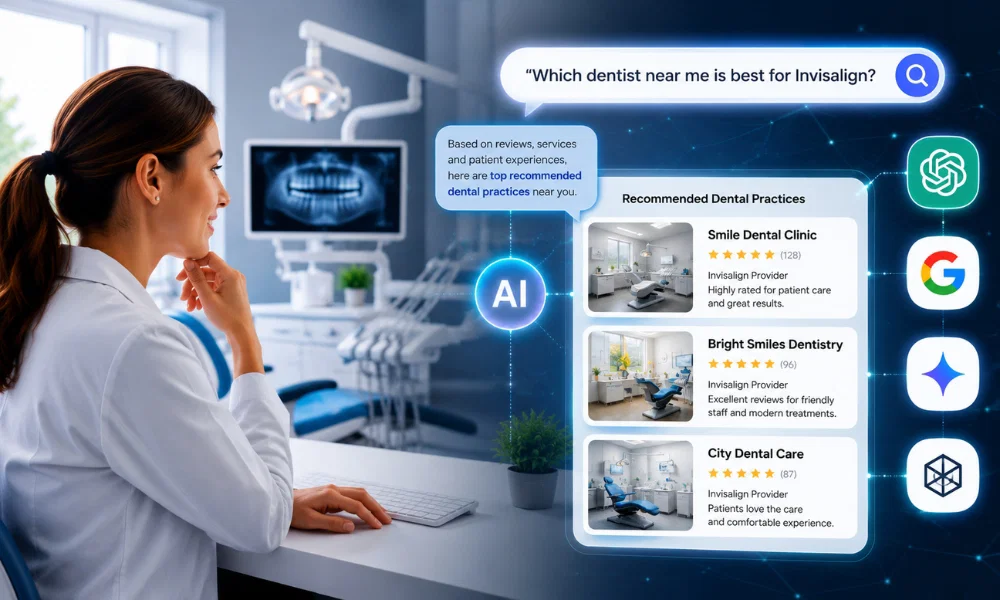
Probably never. And here is the bigger shift: a growing number of patients are no longer scrolling through Google results at all. They are asking questions instead. Questions like “Which dentist near me is best for Invisalign?” or “Is a private dental check-up worth it in Manchester?” And they are asking those questions to ChatGPT, Google AI Overviews, Gemini and Perplexity.
These AI tools do not show ten blue links. They give one confident answer, often with two or three recommended practices. If your clinic is one of them, you win the patient before your competitors even appear. If you are not, you may never know the enquiry existed.
In this post, we will explain how AI search is changing the way patients find dentists in the UK, how these tools actually decide which practices to recommend, and the practical steps you can take right now to become one of the names AI mentions. No jargon, no theory for the sake of it. Just a clear plan you can start this month.
Why AI Search Matters for Your Dental Practice Right Now
For years, dental marketing followed a familiar pattern. A patient typed “dentist near me” into Google, saw the Map Pack and a list of websites, clicked a few, and booked with the one that looked most trustworthy.
That journey is changing fast. Google now shows AI Overviews at the top of many searches, answering the question before a single website link appears. At the same time, patients are going straight to tools like ChatGPT and Gemini and asking longer, more specific questions than they ever typed into a search bar.
Think about what this means in practice:
- A patient asking “best dentist for nervous patients in Leeds” gets a short list of named practices, not a page of links to compare.
- A parent asking “how much does a child’s filling cost privately in the UK” gets an answer pulled from websites that explain it clearly. If your site is one of them, you get cited. If not, a competitor does.
- Someone comparing two local clinics can ask an AI tool to summarise the reviews of both. The AI does the comparison for them.
The patient journey is becoming shorter and more decisive. Fewer clicks, fewer open tabs, faster choices. Practices that show up inside these AI answers are quietly collecting patients that other clinics never get the chance to compete for.
The good news? Most UK dental practices have done nothing about this yet. That makes right now the best possible time to act.
How AI Tools Decide Which Dentists to Recommend
There is no secret submission form for ChatGPT and no way to pay Google to appear in an AI Overview. These systems build their answers from the information that already exists about your practice online. Understanding what they look for is the key to influencing them.
In simple terms, AI search tools favour practices that are:
- Well documented. AI needs facts to work with. Your services, prices, location, opening hours, team, and treatment details need to exist in writing, on pages the AI can read. Vague websites give AI nothing to say about you.
- Consistently described. If your practice name, address and phone number differ between your website, Google Business Profile, and local directories, AI systems become less confident about you. Confidence matters, because these tools are built to only recommend what they can verify.
- Trusted by real patients. Reviews are one of the strongest signals AI tools lean on. Not just your star rating, but the content of reviews. When patients repeatedly mention “great with anxious patients” or “brilliant Invisalign results”, AI tools pick up those themes and repeat them in recommendations.
- Mentioned by others. Being listed in reputable directories, local news, and industry sites tells AI systems that your practice is a real, established business. This is one reason traditional dental SEO work still matters so much. The same signals that help you rank on Google help you get recommended by AI.
- Clear and specific in content. AI tools prefer content that directly answers questions. A page titled “Emergency Dentist in Croydon: Same Day Appointments and Costs” gives an AI something concrete to cite. A page titled “Welcome to our practice” does not.
- Notice something important here. None of this replaces SEO. AI search visibility is built on top of strong local SEO, not instead of it. If your foundations are weak, no amount of “AI optimisation” will fix it. That is why our AI search optimisation for dentists work is built on the same foundations as our dental SEO service, rather than sold as a separate gimmick.
Step 1: Make Your Google Business Profile the Best Source of Truth
If you only do one thing after reading this post, do this. Google AI Overviews lean heavily on Google Business Profile data, and other AI tools reference it too because it is structured, verified information.
Here is what a strong profile looks like in 2026:
- Every field completed. Services, categories, opening hours, appointment links, accessibility details, payment options. Empty fields are missed opportunities to be matched with patient questions.
- Services listed individually. Do not just say “general dentistry”. List Invisalign, implants, hygiene appointments, emergency care, whitening and children’s dentistry as separate services with short descriptions. Patients ask AI about specific treatments, so your profile should speak in specific treatments.
- Fresh photos and regular updates. Profiles that are actively maintained are treated as more reliable than ones that have not changed since 2022.
- Questions answered. The Q&A section of your profile is often quoted in AI answers. Seed it with the questions patients actually ask at reception, and answer them properly.
Getting this right is the heart of our local SEO for dentists work, and we broke the tactics down in our guide to the top three map results. Everything in that guide now does double duty. It helps you rank in the local pack and it feeds the AI systems that recommend practices.
Step 2: Publish Content That Answers Real Patient Questions
AI tools are answer engines. To be cited by an answer engine, you need to be the source of good answers.
Start by collecting the questions your practice hears every week. Your reception team is a goldmine for this. Typical examples:
- How much does a private check-up cost?
- Do you take nervous patients?
- Is Invisalign better than braces for adults?
- What should I do about a chipped tooth on a weekend?
- Can I register if I have not seen a dentist in ten years?
Then answer them properly on your website. A few rules make the difference between content AI cites and content it ignores:
- Answer first, explain second. Open each section with a direct answer in one or two sentences, then add detail. AI tools extract these concise answers easily.
- Use real numbers where you can. Price ranges, appointment lengths, recovery times. Specific facts get cited. Vague statements do not.
- Write for one location. “Teeth whitening costs in Birmingham” will earn AI mentions that a generic national page never will, because most patient questions are local.
- Add FAQ sections with schema markup. Structured FAQ data makes it easier for both Google and AI tools to lift your answers. This is standard practice in our on-page work, and our on-page SEO checklist for dental websites walks through the technical side.
One honest warning: do not mass-produce generic AI-written pages to tick this box. These systems are getting better at recognising thin, duplicated content, and it damages the trust signals you are trying to build. Ten genuinely useful pages beat a hundred filler ones.
Step 3: Turn Your Reviews Into an AI Recommendation Engine
When a patient asks an AI tool “which dentist in my area is good with anxious patients”, the AI does not guess. It scans review content and repeats the themes it finds.
This changes how you should think about reviews. Volume and star rating still matter, but the words inside reviews now matter just as much. A practice with 200 reviews that mostly say “great service” will lose AI recommendations to a practice with 80 reviews that specifically mention sedation options, gentle hygienists and pain-free implant treatment.
Practical ways to shape this:
- Ask at the right moment. Request reviews straight after positive appointments, when the experience is fresh and specific.
- Prompt gently for detail. A message like “We would love to hear what treatment you visited us for and how you found it” produces richer reviews than a bare link.
- Respond to every review. Responses add more indexed text about your practice and show both patients and AI systems that the clinic is active and engaged.
- Handle negative reviews professionally. AI tools summarise sentiment. A calm, helpful response to criticism reads far better in a summary than silence.
If review generation feels like one more job your front desk does not have time for, this is exactly what our online reputation management for dentists service automates, from one-click review requests to monitoring across platforms.
Step 4: Be Ready When the AI-Referred Patient Arrives
There is a final step most guides skip. Getting recommended by AI is only half the job. AI-referred patients behave differently when they land on your website.
They arrive further along in their decision. The AI has already answered their basic questions and shortlisted you. What they want now is confirmation and a fast way to book. If they hit a slow site, a buried phone number, or a contact form that goes unanswered until Monday, that hard-won recommendation is wasted.
Make sure your website can convert this traffic:
- Clear booking buttons on every page, visible without scrolling
- Pricing information that matches what your content and reviews suggest
- A way to get answers instantly, even at 9pm on a Sunday when many of these searches happen
That last point is where an AI chatbot earns its keep, engaging visitors the moment they arrive and capturing the enquiry before they go back and try the next practice on the AI’s list. That is what our AI chatbot and lead conversion service is built for, and our guide to converting website visitors explains how it works.
Quick Wins You Can Action This Month
If the full picture feels like a lot, start here. These steps deliver the most AI visibility for the least effort:
- Audit your Google Business Profile and complete every empty field, listing each treatment as a separate service.
- Check your name, address and phone number across your website, Google, and your top five directory listings, and fix any mismatches.
- Publish three question-based pages answering the most common questions your reception team hears, each opening with a direct one-sentence answer.
- Add FAQ schema to your key service pages.
- Send review requests to your last 20 happy patients, asking them to mention the treatment they had.
- Test it yourself. Ask ChatGPT and Gemini to recommend a dentist for your main treatments in your town. Note who appears, look at what those practices have online, and track whether you start appearing over the next few months.
Repeat that final test monthly. It is the simplest AI visibility report you will ever run, and it keeps the whole team motivated when your practice starts showing up.
The Practices That Move First Will Own This Channel
AI search is not a passing trend, and it is not a threat if you prepare for it. It is a new front door to your practice, and right now that door has very little competition standing in front of it.
The work is not mysterious. Strong local SEO foundations, a complete Google Business Profile, content that genuinely answers patient questions, reviews rich with detail, and a website ready to convert. Practices that put these pieces in place over the next six months will be the names AI tools recommend by default in their area. Everyone else will be trying to catch up.
If you would rather have specialists handle it, this is exactly what we do. QualiConvert builds AI-ready visibility for UK dental practices through our AI search optimisation service, and we will show you exactly where your practice stands today. Book your free consultation and ask us to run an AI visibility check on your practice. It takes minutes, and the results usually surprise people.
FAQs
No. There is currently no paid placement inside AI-generated answers. Recommendations are earned through the quality, consistency and trustworthiness of your online presence, which is why the groundwork above matters so much.
No, it builds on it. AI tools draw on the same signals that power Google rankings: your website content, local listings, reviews and mentions. Strong dental SEO is the foundation of AI visibility, not an alternative to it.
It varies by area and competition. Practices with solid foundations often see mentions within three to six months of focused work. Testing monthly with real patient-style questions is the best way to track progress.
Yes, often a better chance. AI tools favour specific, locally relevant, well-reviewed practices over generic corporate pages. A small clinic with detailed content and rich reviews can outrank a chain’s template website in AI answers.