Every week, a dental practice owner somewhere in the UK gets told they “need to be on TikTok”, “should be running ads”, “must do email marketing” and “can’t ignore SEO”. All at once. Usually by different salespeople.
The truth is less exhausting. Digital marketing for dentists is not about being everywhere. It is about putting a limited budget into the two or three channels that fit your practice’s stage, area and goals, and ignoring the rest without guilt.
This guide gives you an honest verdict on each major channel: what it costs, what it delivers, how fast, and which practices it suits. No channel gets sold to you here. Some get told off. By the end, you will know exactly where your next pound of marketing budget should go.
Before Choosing Channels, Answer One Question
How quickly do you need patients?
Every dental digital marketing channel sits somewhere on a trade-off between speed and cost-efficiency. Paid channels deliver enquiries this week but cost the same forever. Organic channels take months to build but keep delivering long after the work is paid for. Practices in different situations should choose differently:
- New practice, empty diary: You need speed. Paid channels first, organic building in parallel.
- Established practice, steady but plateaued: You need efficiency. Organic channels first, paid used surgically for high-value treatments.
- Growing practice pushing implants or Invisalign: you need both, because those patients research heavily across multiple touchpoints before booking.
Keep that in mind as we go through the channels.
SEO and Local Search: The Foundation
When patients need a dentist, they search. The practices that appear organically, in both the Map Pack and standard results, collect enquiries every day without paying for each click. That is what makes SEO the most cost-efficient dental marketing channel once established: the cost per patient keeps falling the longer it runs.
The trade-offs are honest ones. Results take 4 to 6 months to build, and the work is genuinely ongoing: content, local signals, reviews, technical health. We explained exactly how Google decides which dental practice ranks first in a separate guide, and how much it should cost in our dental SEO pricing breakdown.
One shift makes this channel even more important: AI search. Patients increasingly ask ChatGPT and Google AI Overviews to recommend dentists, and those tools draw on the same signals SEO builds. Investing here now covers you for both.
Best for: every practice with a 6+ month horizon.
Skip if: you need patients this fortnight and have no budget for anything else, in which case start with ads and add SEO the moment you can.
Google Ads: Speed You Pay For
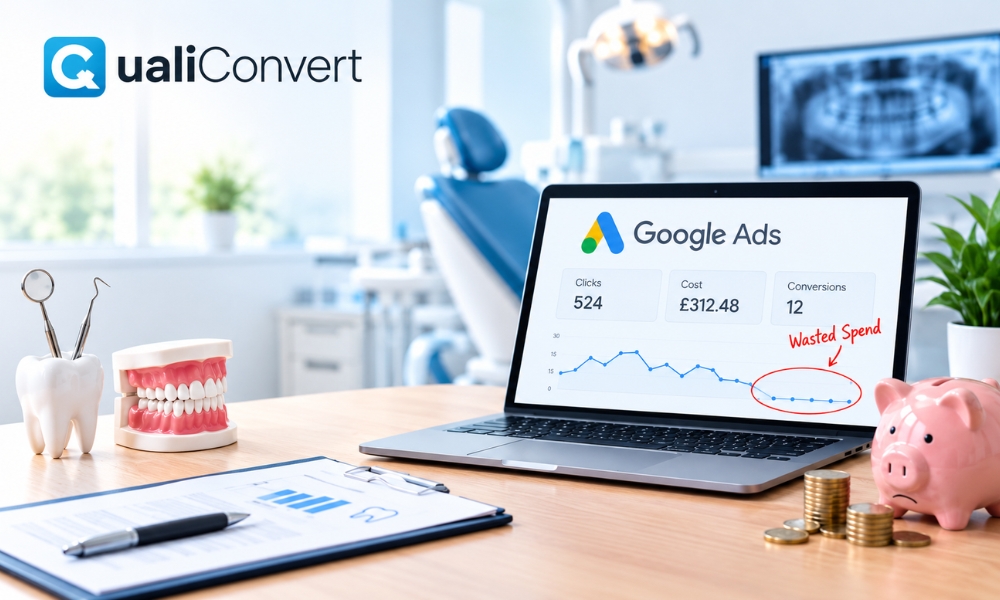
Google Ads puts you at the top of search results today. For a new practice, or for competitive treatments like implants where one patient covers a month of ad spend, that speed is genuinely valuable.
The honest caveats: dental keywords in the UK are expensive, competitive terms can cost several pounds per click, and clicks are not patients. The practices that win with ads are the ones that send clicks to dedicated, persuasive landing pages and answer the phone quickly. The practices that lose are the ones that send expensive clicks to their homepage and let enquiries sit until Monday.
Budget realistically: meaningful campaigns generally need £1,000+ per month in ad spend before management costs, and everything stops the day you pause it.
Best for: new practices, high-value treatment campaigns, filling short-term capacity.
Skip if: your website does not convert visitors yet. Fix that first or you are paying to demonstrate the problem.
Social Media: Trust Builder, Not Patient Machine
Here is the honest truth most agencies will not say: very few patients choose a dentist because of a social media post. What social media does brilliantly is confirm the choice. Patients who found you through search or a recommendation will check your Instagram and Facebook before booking, and an active, human profile with real team photos, patient stories and genuine results closes that trust gap.
That reframing changes the strategy. You do not need daily posts, dances or viral ambitions. You need a consistent, credible presence: two or three posts a week showing real people and real work, active responses to comments and messages, and local relevance. Facebook and Instagram carry most of the weight for UK practices; TikTok is optional and only worth it if someone in the practice genuinely enjoys making videos. If you do lean into video, our guide on how dental practices can use video marketing shows the formats that work without a production crew.
Best for: every practice, at a sustainable minimum.
Skip: paid social campaigns for general dentistry; the intent is too low. Paid social can work for cosmetic treatments with strong visuals, but treat it as an experiment, not a pillar.
Email and SMS: The Channel Everyone Forgets
Every channel above chases new patients. Email and SMS talk to people who already know you: lapsed patients, patients due a hygiene visit, patients who enquired about Invisalign and went quiet. Reaching them costs pennies, and they convert at rates no acquisition channel can touch, because trust already exists.
The bar is low. A monthly practice update, automated recall reminders, and a simple reactivation message to patients not seen in 18 months will outperform far more expensive activity. The usual blocker is not cost but admin time, which is exactly what automation solves. Our AI chatbot and lead conversion tools handle the capture side, making sure every website enquiry actually enters your system instead of evaporating.
Best for: every established practice with a patient list.
Skip if: you are brand new with no list yet. Build one from day one.
Directories and Comparison Sites: Necessary, Then Ignore
Consistent listings on Google, Bing Places, and the major UK healthcare directories support your local SEO and catch a small stream of direct enquiries. Set them up accurately, keep the details matching your website, and move on. Paid premium listings on general directories rarely justify their cost for dental practices; that money nearly always works harder in the channels above.
Putting Your Budget Together
A simple, defensible allocation for a typical established UK practice investing in growth:
- 50 to 60 percent into SEO and local search, because it compounds and feeds everything else
- 20 to 30 percent into Google Ads, focused tightly on your highest-value treatments
- 10 to 15 percent into social media, enough for consistency and credibility
- 5 to 10 percent into email, SMS and retention, the highest-return slice of the whole budget
A new practice flips the first two for six months, then rebalances as organic visibility arrives. Whatever the split, commit for at least six months. Channel-hopping every quarter is the most reliable way to make every channel look like it does not work.
For the tactical layer underneath these channels, our guide to dental marketing strategies that actually work in the UK picks up where this one ends.
Or Have One Partner Run the Whole System
Channels work best when they work together: ads sending visitors to pages SEO strengthened, reviews feeding the Map Pack, chatbots capturing the enquiries every channel generates. Coordinating that across separate freelancers and platforms is where most practices lose money and patience.
QualiConvert exists to be that single partner for UK dental practices. Our dental digital marketing services combine SEO, paid campaigns, reputation and AI-powered lead conversion under one monthly subscription with no long-term contract, tracked in one dashboard. Book a free consultation and we will tell you which channels your practice actually needs, including the ones you can safely ignore.
FAQs
For most UK practices, SEO and local search deliver the best long-term return because patients actively search for dentists and organic visibility compounds over time. The best first channel, though, depends on urgency: new practices often start with Google Ads while SEO builds.
UK practices serious about growth typically invest around 5 to 10 percent of revenue in marketing. For most single-location practices that means a total of £1,000 to £4,000 per month across channels, weighted towards SEO and, where relevant, paid ads.
Directly, rarely. Social media mainly works as a trust layer: patients who found you elsewhere check your profiles before booking. A modest, consistent, human presence achieves that; large social budgets seldom pay back for general dentistry.
No. Two or three channels done consistently beat six done thinly. Start with search (organic, paid, or both depending on urgency), add retention email early because it is nearly free, and layer in social at a sustainable minimum.